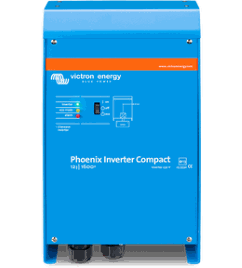
Power Inverters - An Introduction
Inverters convert battery power (12v or 24v dc) to mains power
(240v
ac). They are very convenient, as they allow the use of standard
"mains" appliances on a DC (battery) system.
Unfortunately, inverters are normally only suitable for occasional use
on a remote solar or wind power system. They are great for washing
machines, power tools and vacuum cleaners which tend to have shorter
running times. However, due to the standby and internal power losses in
even the most efficient inverters, loads such as lighting and
refrigeration are often run direct from DC.
The larger the inverter, the larger the self-consumption figure. Power
inverters are often fitted with remote switches so that they can be
turned off easily when not in use. It also makes sense to try and match
the inverter to the load, as running a small load from a large inverter
will be inefficient.
Power inverters are very useful in vehicles, as they provide a totally
independent mains power supply. In this situation, we often recommend
that clients consider having a larger or second battery fitted to the
vehicle to cope with the extra power draw.
Two Types of Power Inverter
There are two main types of DC to AC inverter – Modified Sine
Wave (aka
Quasi Sine) and True Sine Wave. Modified sine inverters are cheaper,
but the power is a little rough. This can occasionally produce problems
with some devices, such as TV's and stereos. True sine wave inverters
produce exceptionally high quality power, and run all types of
equipment.
Our Inverter Range
Victon
Inverters - 12v, 24v or 48v input, true sinewave, rugged design from 180w to 5000w.
Solon
Inverters (Ex ASP) - 12v, 24v or 48v input, true sinewave, industrial inverters from 150w
to 3400w.
We also supply solar
panels, wind
turbines, batteries, controllers and a wide range of accessories.
|