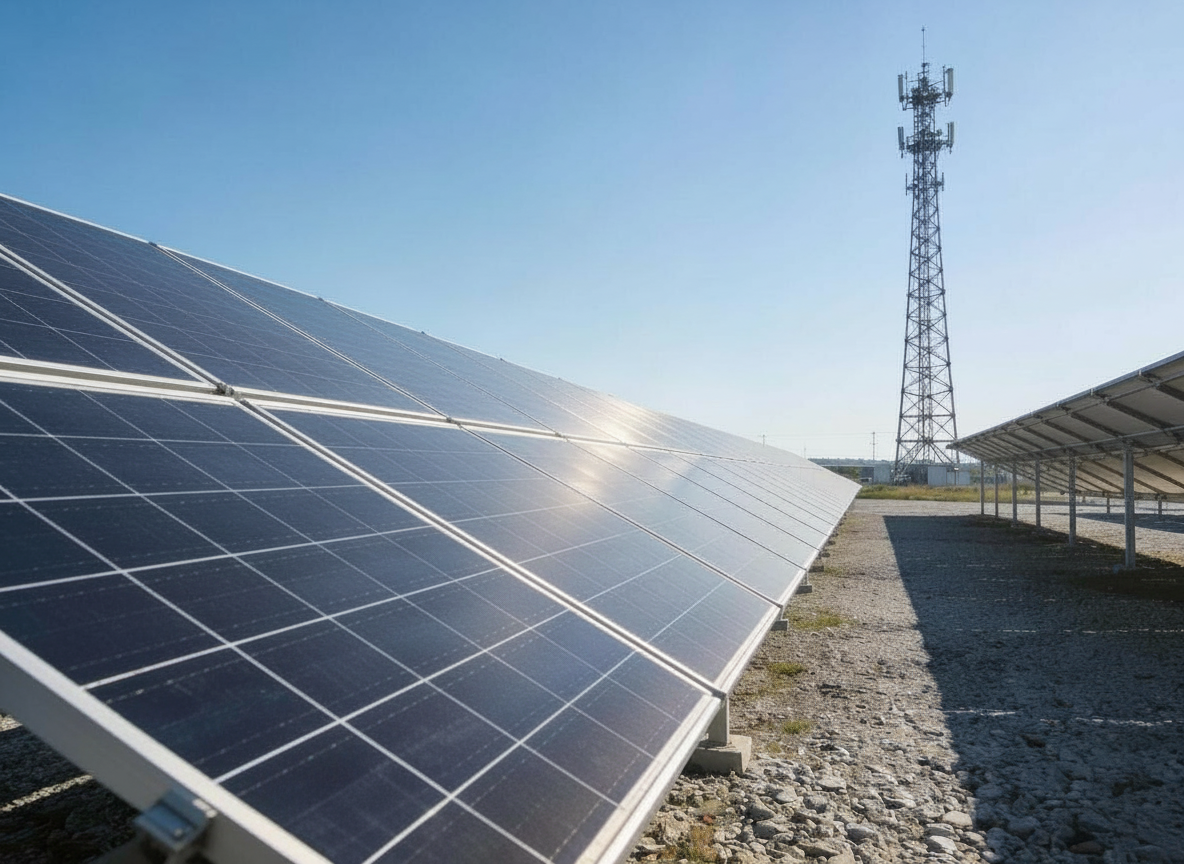
In 2026, the world will surpass 19 billion mobile devices, with over 6 billion unique users relying on unbroken connectivity.
Expanding telecom networks into remote areas faces a massive financial hurdle: the cost of power. Running cables from the nearest substation to an isolated site often costs a fortune in trenching, permits, and delays—sometimes exceeding £100k ($130k+) per site.
Relying solely on diesel generators isn't the answer either; spiralling fuel costs, frequent refuelling trips, and high maintenance eat into profits and operational efficiency.
The Solution: Solar-Primary Hybrid Power
Off-grid solar and wind energy have evolved into the reliable, economical standard for powering telecommunication systems at remote sites. By using renewables as your primary power source and retaining a generator only for backup, you eliminate grid extension CAPEX and reduce diesel OPEX by up to 80%.
This "hybrid" approach delivers rock-solid reliability for critical applications, including:
-
Base Stations (BTS): 4G/5G macro and micro sites.
-
Broadband Links: VSAT, WiMAX, and Microwave backhaul.
-
Edge Connectivity: WiFi access points, RF endpoints, and Cellular/SONET repeaters.
-
Critical Comms: Two-way radio networks and security telemetry.
Why Switch to Off-Grid Solar & Wind?
Research confirms that hybrid renewable systems offer the lowest Total Cost of Ownership (TCO) for remote sites.
Eliminate Cabling Costs
Bypass the grid entirely. These systems are ideal for exposed hilltops offering excellent wind resources, or open flat terrain perfect for solar arrays, removing the need to trench cables across difficult ground.
Guarantee Reliability (Global Performance)
Power systems should be matched to the site location. In northern latitudes, hybrid systems are often superior because wind generation peaks in winter when solar is weakest, ensuring year-round balance. Closer to the equator, systems are typically biased towards solar to exploit consistent high irradiance. Combined with battery storage and a backup generator, this approach can support very high uptime.
Slash Operational Costs
Reduce generator runtime from 24/7 to just a few hours a year. This extends maintenance intervals, reduces expensive site visits, and protects you from international fuel price spikes.
Maximise Efficiency
Most modern telecoms equipment runs natively on 48V DC. Powering it directly from a DC based solar / wind / battery supply eliminates inverter losses, making your system 10-15% more efficient than AC-based alternatives.
Future-Proof & Green
Meet sustainability targets with zero-emission primary power, crucial for energy-intensive 5G networks.
24/7 Remote System Monitoring: Complete Control
Stop guessing and start managing. Our advanced remote telecom monitoring platforms give you total visibility over your entire network from a single dashboard, anywhere in the world.
-
Real-Time Insights: Check solar yield, wind output, battery status, and load consumption live from your phone or laptop.
-
Proactive Alerts: Receive instant notifications for anomalies—like panel shading or low battery voltage—allowing you to fix issues before they cause downtime.
-
Predictive Maintenance: Analyse historical data to spot degrading components early, reducing emergency engineer call-outs by up to 80%.
-
Smart Management: Perform over-the-air firmware updates and adjust settings remotely to optimise performance without setting foot on site.
Global Power Solutions for Your Network
Don't let power limitations dictate your coverage map. We specialise in supplying equipment for off-grid power systems, whether you are deploying in the UK, Europe, Africa, or beyond. Your own engineer or installer designs the system to suit your load profile and location, and we supply quality equipment you can trust, even in the most challenging environments.
Ready to cut costs and boost reliability?
Our technical team can advise on the equipment we supply for your remote site.