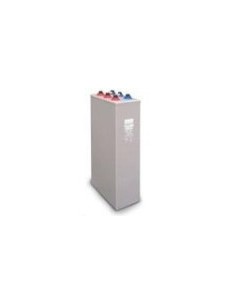
Batteries - An Introduction.
Batteries are used to store
energy, just like a fuel tank in a car. Just like a fuel tank, they do
not produce energy. The energy taken out needs to be replaced or the
battery will eventually run out of power.
The
most popular types for
solar and wind applications are deep cycle lead acid batteries.
From the cost and reliability perspective, this established technology
continues to dominate. Lead acid batteries have to be treated with care
or they will need
replacing very quickly.
The care they require is
quite simple - they must not be over-charged or over-discharged.
In a solar or wind energy system, the charge controller takes care of
the batteries, ensuring that they give an optimal life. For gel or AGM
batteries, little or no user
maintenance is required. Wet unsealed batteries need occasional topping
up with distilled water.
Heavy Duty Deep Cycle Batteries
The difference between a
proper heavy duty 'deep cycle' battery and the 'starting' battery on a
car is
significant. A car battery is designed to produce a short burst of
power to start the engine. A deep cycle battery is designed to provide
power over a far longer period of time.
If you use a car battery on
any system which discharges the battery deeply, the car battery will
fail quite quickly. The stress of a deep discharge often permanently
warps the lead plates, causing a shorted cell.
For this reason, deep cycle
batteries have far heavier and stronger lead plates inside of them.
This enables them to better withstand the stress of a deep discharge.
It also makes them more expensive, as these days, lead is very costly.
Leisure
batteries and marine batteries are generally a cross between a starting
battery and a deep cycle battery. They are cheaper than true deep cycle
batteries due to the fact that they use less lead in their construction.
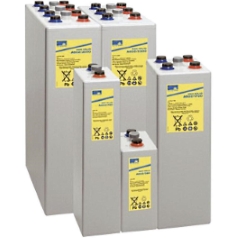
Long-life deep cycle industrial batteries
are produced in 2v cells, which are joined together on site to provide
the correct voltage (i.e. 12 x 2v cells = 24v battery bank). This
enables the assembly of massive battery banks, which otherwise would be
virtually unmovable as a single unit.
The the amount of energy a
battery can store is rated in Ah (Amp hours). It varies depending on
how quickly the power is taken out, however most batteries are rated at
the 20hr or 100hr rate. This means that a battery rated at '100Ah @
C20', is able to produce 100Ah when discharged over 20hrs, i.e. a
constant load of 5 amps.
The life of a battery is
expressed as 'design life' or 'cyclic life'. If a battery is not cycled
much, it will normally last for the design life. If a battery is cycled
regularly, its life will depend on the depth of the discharge cycle and
the number of cycles it has to do. This data is often shown plotted on
a graph by the manufacturers and is the key to a good deep cycle
battery.
Batteries for Solar, Wind or Off-Grid Power Systems
At the EDC we supply batteries with storage capacities
from
7Ah to
4600Ah in a single cell. These can be combined to provide battery banks
with many thousands of amp hours of storage.
We supply the following types of batteries, all suitable for charging
from solar pv panels or a wind turbine. Please visit the links below
for further information such as prices, data sheets and performance
graphs.
Sonnenschein Dryfit Solar Block Gel Batteries -
6v & 12v blocks, maintenance free, 60Ah to 330Ah. MK Solar Gel Batteries - 6v & 12v blocks, maintenance free, 36Ah to 265Ah. Sonnenschein
Dryfit A600 OPzV Solar - 2v Gel, maintenance free, long life cells,
240Ah to 3500Ah.
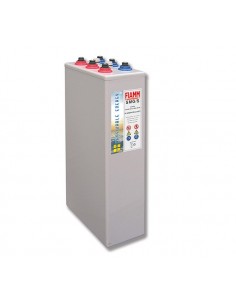
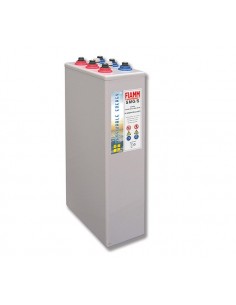
Fiamm
Industrial OPzV SMG Batteries - 2v Gel, maintenance free, long life
cells, 240Ah to 3600Ah.
Exide
Classic Solar OPzS - 2v Wet, long life cells, 190Ah to 4600
Ah.
Exide
Powerfit 12v AGM Batteries - Absorbed Glass Matt, 12v Blocks, 7Ah
to 40Ah.
Related Pages
|