
Your cart
There are no more items in your cart
Livestock Water Supply in a Drought: What Happens If Your Mains Fails?
You go out at six in the morning and the trough is empty. The tap gives you nothing. You have 40 cows in milk, and between them they will want around 4,200 litres today. Who is coming to help, and when?
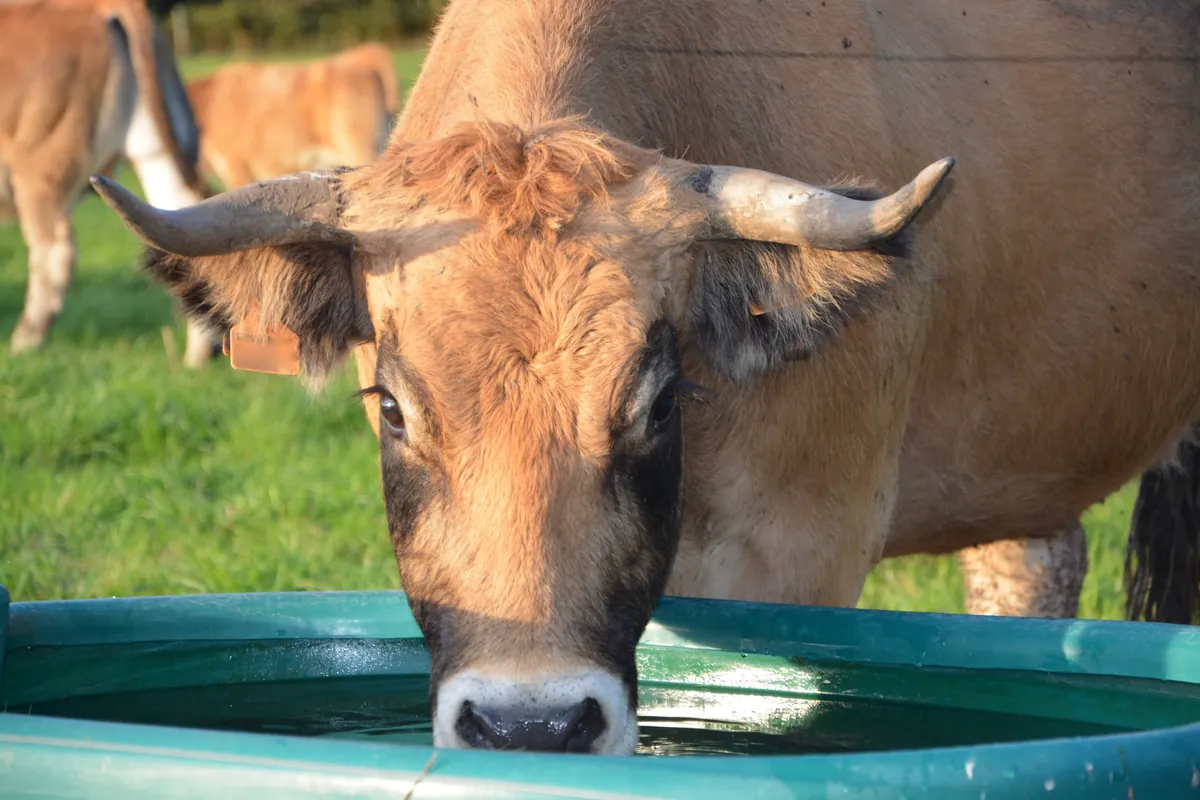
Livestock water supply is one of those things nobody thinks about until the mains fails. This is a plain look at how long your stock would actually be without water, how much they drink, and how a solar water pump on a supply you own takes the problem away.
The short version
- A dairy cow in milk can drink 68 to 155 litres a day, so a 40 cow herd needs around 4,200 litres.
- Guidance says distress is likely after 24 hours without water, and one water company aims to get help to farms within 48 hours.
- Your own borehole or pond, a solar pump and a buffer tank closes that gap.
How long will your cattle have drinking water?
South East Water has launched a livestock register. It aims to get alternative water to farms within 48 hours of an interruption, for holdings with six or more animals in its supply area, and it tells farmers not to rely only on that. In Northern Ireland, DAERA guidance says animals are likely to suffer distress if they go without water for more than 24 hours.
Those two numbers do not match, and your cattle would be standing in the gap between them. The 48 hour figure is one company's target for its own area, so check what applies to you.
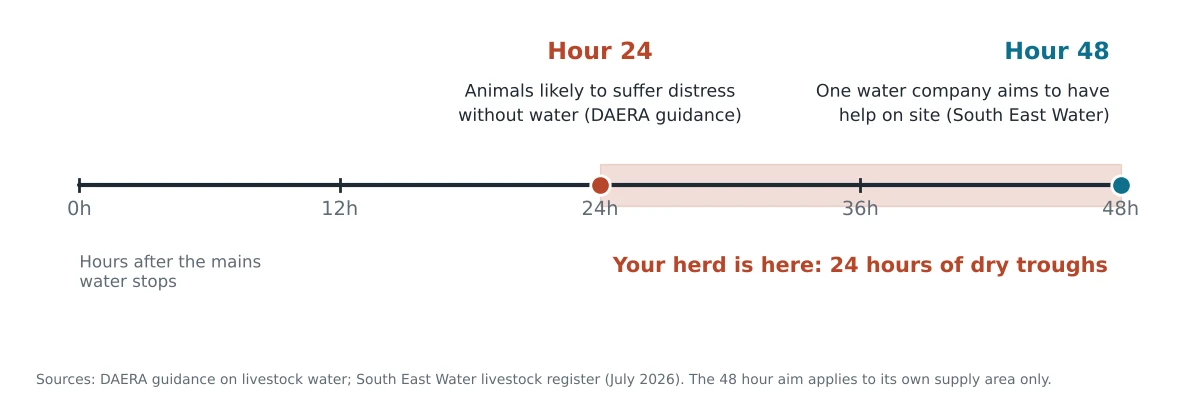
24 hours is DAERA's guidance on distress. 48 hours is South East Water's aim for its own supply area.
How much water do cattle drink?
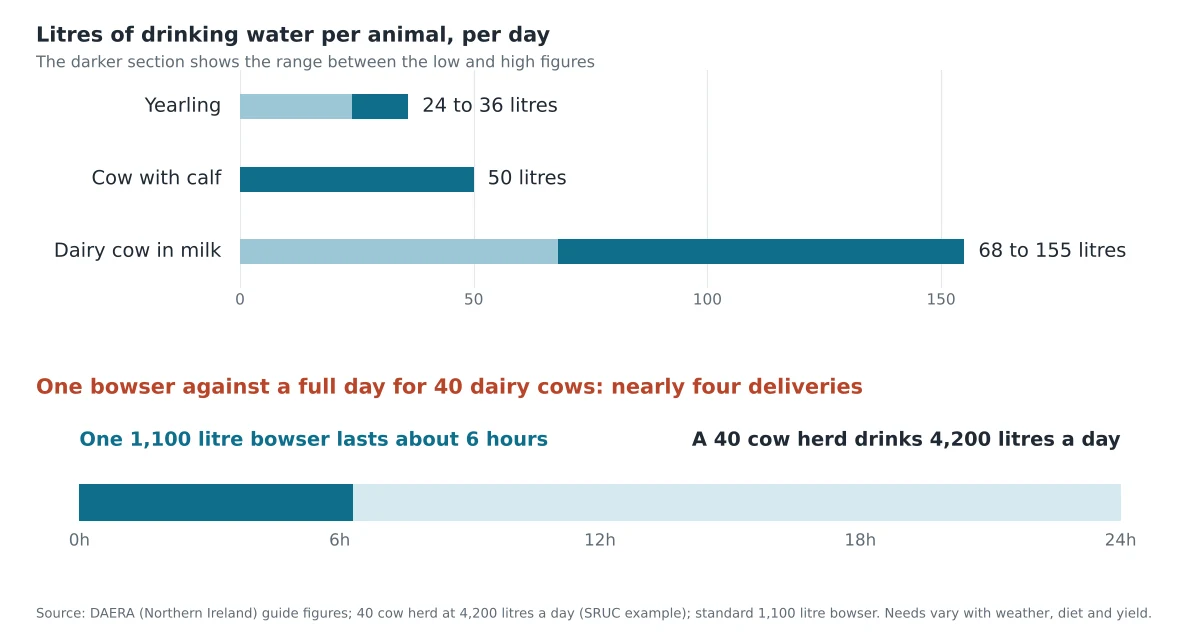
A dairy cow in milk can drink between 68 and 155 litres a day, according to DAERA. A cow with a calf needs around 50, and a yearling 24 to 36. A standard 1,100 litre bowser covers about a quarter of the 4,200 litres a 40 cow herd drinks in a day, so one delivery does not go far. Cows can also drink up to 14 litres a minute, so a trough that was full at lunchtime can be empty again before you have finished your tea.
Why drought is a real risk for UK farms now
The Environment Agency has recorded 425 drought and dry weather incidents this year. It is the third drought in five years, and the NFU expects the effects to carry on into 2027. In late October the Environment Agency reported groundwater still falling at most sites, because dry soils limit recharge.
Mains water is also getting dearer. Ofwat has allowed bills to rise by an average of 36% over five years, and some business wholesale charges went up much more than that this April. You end up paying more for a supply that can fail, with a lot of buried pipe between the meter and your furthest trough. Any leak on that pipe is water you pay for and never get.
Working out how much water your herd needs
It is worth ten minutes with a pen. Work out how many litres your stock drink on the hottest day of the year, how many hours your tank would last at that rate, and what you would do on day two if the mains was still off.
If you do not like the answers, the usual fix is a water supply you control yourself: your own source, a solar pump and a buffer tank.
Will a borehole run dry in a drought?
It can, if it is shallow or in the wrong rock, so it pays to plan for the low point and not the average. At the end of October, five of the 26 Environment Agency indicator sites in England were exceptionally low, mostly in chalk and limestone. Those sites record the natural water table, not the output of any farm borehole, but they show how far levels can fall.
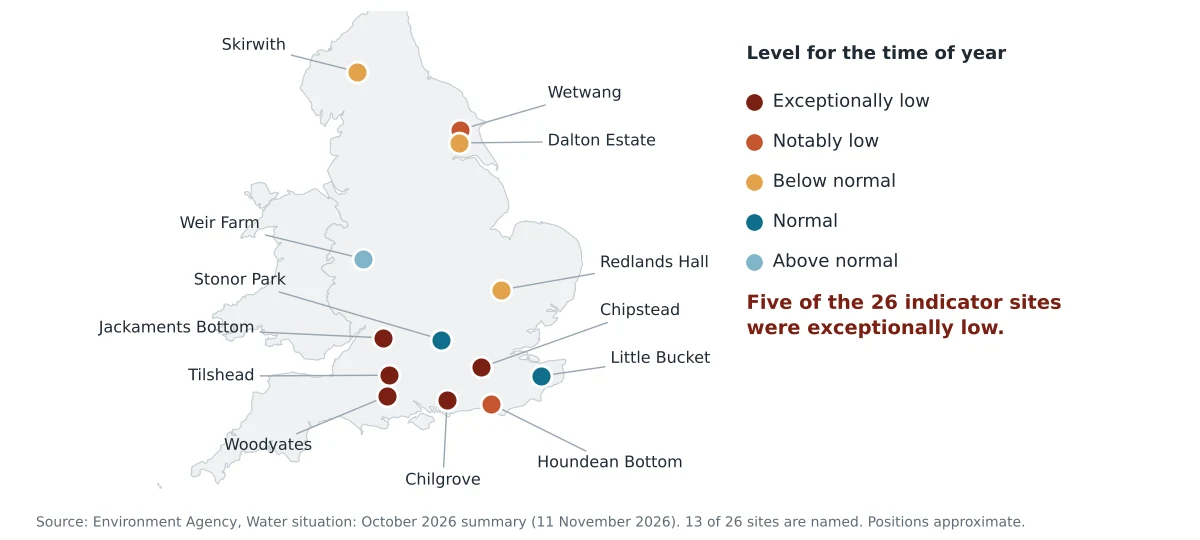
Environment Agency indicator boreholes at the end of October 2026. The map shows how far levels fell, which is why depth and testing matter.
That is why you test before you rely on one. Get a yield test, have it drilled deep enough to cope with a dry year, and ask local drillers how nearby boreholes coped this summer. A borehole built that way, with a covered tank and a pond or second source as backup, is a supply you control. A mains failure is one you can only wait out. Our guide to a solar borehole pump system explains how the pump, panels and tank fit together.
Do you need a licence for a livestock water supply?
In England, taking 20 cubic metres (20,000 litres) a day or less does not need an abstraction licence. If you take water from the same source at several points, the combined total counts. A typical herd sits well under that. Your 40 cows drink about 4 cubic metres a day, and you would need something like 130 cows drinking 155 litres each to reach the limit. Check with the Environment Agency before sinking a borehole, because you may need consent to construct it and test pump it, and the rules differ in Wales.
Why a solar water pump suits livestock
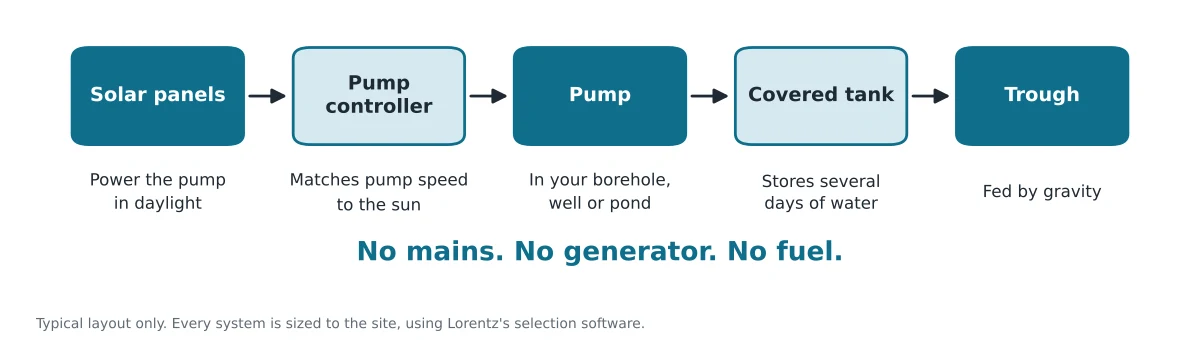
A solar pump delivers the most water when it is sunny and the days are long, which is when your stock drink the most. It needs no mains electricity or generator, so it keeps working when the grid does not. It also suits fields a long way from the yard, where running a mains pipe would cost a fortune. Our Lorentz solar pump range covers most livestock jobs, and Lorentz publish a guide to cattle watering with solar pumps (PDF).
Most of the pump systems we supply are PV-direct, which means the panels run the pump straight from the sun with no battery to maintain or replace. The trade-off is that output rises and falls with the light, so a duller day gives you less water. That is what the tank is for: size it so the herd has a day or two in hand, and the pump tops it up whenever the sun comes out. We have supplied off-grid solar and wind systems for 29 years and are an authorised UK Lorentz partner, so the sizing is done with Lorentz's own selection software.
Covered tanks and storage
A tank on its own is not drought insurance. It buys you time, and that is all. A covered tank is still worth having as a buffer between the pump and the trough. Algae need light to grow, so keeping the water covered cuts the risk of a bloom. The pump fills it in the day and the cattle drink from it day and night.
Can cattle drink from a pond in a drought?
When the mains fails or a trough runs dry, the pond is the obvious fallback. It is also where the risk is highest.
Blue-green algae like warm, still, nutrient-rich water, and a drought gives them exactly that. Levels drop, the water warms up, and anything running off the fields ends up more concentrated. You cannot tell by looking whether a bloom is toxic, so treat every bloom as if it is. Government hot weather guidance says poisoning in livestock can show up as sudden deaths, with more than one animal involved. Boiling the water will not remove the toxins, and treating the pond with copper sulphate can make things worse, because toxins are released when the algae cells die.
Cattle make it worse themselves. They stand in the water, churn up the silt and add dung and urine, which feeds the next bloom. The wind also pushes scum to one bank, and that is often the bank they drink from.
If you spot a bloom, report it to the Environment Agency on 0800 80 70 60 and keep the cattle away.
Pumping water out of a pond into a trough
The better way to use a pond is to keep the cattle out of it. Fence it off, then run a solar pump to a trough somewhere else. Advice from US agricultural extension services is to draw from mid-depth in the middle of the pond, away from the surface scum at the edge, and a floating or raised intake does this better than a pump dropped over the bank.
You can go one step further. If the pump has spare capacity, the tank overflow can run back into the pond, at the opposite end from the intake, so the water keeps moving while the sun is out. Keeping the water moving may help reduce the risk of blooms, but it does not remove the risk. Regulators and extension services in the US describe mixing as one tool among several, and it works best alongside cutting nutrient run-off. Pond depth and size affect how well it works, so check with your pump supplier before relying on it. Your pump supplier or vet can also advise on the intake position.
One caution on ponds generally. A pond that is low can be nearly empty, so check how much it holds and how fast it refills before you rely on it for a herd through a dry summer. If it cannot keep up, a borehole is safer, with the pond as a backup.
Grants for livestock water supplies
In England, Defra has said it is reopening the Water Management Grant for a third round, with up to £15m for on-farm reservoirs. At the start of November it had not yet opened and the detailed eligibility rules were still to be published. Earlier rounds were for arable and horticultural businesses only, so check the rules when they appear before you count on it. In Wales, the Capital Production and Efficiency grant can cover boreholes and water harvesting equipment.
Get a solar pump system sized for your farm
If you would like to know what it would take on your farm, send us the peak daily litres you need, how deep or how far away your water source is, and how far and how high the water has to go. We size every system with Lorentz's own selection software, then supply it and give you a price. Sizing is free.
Not sure how a borehole pump system works? Read our solar borehole pump guide first.
Common questions
How long can cattle go without water?
DAERA guidance says animals are likely to suffer distress if they are deprived of water for more than 24 hours, and hot weather and lactating cows make that worse.
How much water does a dairy cow drink a day?
A cow in milk can drink between 68 and 155 litres a day. Allow for the hottest day of the year when you size storage and pumping.
Do I need a licence to take water for my livestock?
In England, you need an abstraction licence above 20 cubic metres a day, counting everything you take from the same source. Below that you usually do not, but check with the Environment Agency before drilling.
Is it safe for cattle to drink from a pond?
Not in warm weather, because blue-green algae blooms can poison stock. Fence the pond off and pump water to a trough, or use a borehole.
Sources
- South East Water: supporting our agricultural community
- DAERA: general advice on livestock water requirements
- Environment Agency: water situation, October 2026 summary
- Defra: new drought support for farmers
- GOV.UK: hot weather and potential risks to health and welfare
- GOV.UK: check if you need a licence to abstract water
- Environment Agency: dry weather and drought, 23 to 29 October
- Welsh Government: dry weather support
Last updated 14 November 2026
Related posts
 Marinising Solar PV Modules for Boats & Yachts
What to consider when selecting solar pv modules for marine use and what you can do to ensure long-term reliability...
Read more
Make Your Off-Grid Wiring 4x More Reliable
How to make your off-grid solar pv or wind installation safer, neater and more reliable.
Read more
When Is A Fuse Not A Fuse ?
Ensure your off-grid power system is properly protected - use the correct fuse. This article discusses the importance...
Read more
Your Off-Grid LiFePO4 Battery Will Never Use Its Cycle Life
Datasheets lead with cycle life, but an off-grid battery sized for days of autonomy will never use most of it. Heat...
Read more